
Foodservice and Takeout
Custom Foodservice & Takeout Packaging
Printed packaging for restaurants and food businesses: boxes, containers, bowls, wrap sheets, napkins and labels. Tell us what you serve and how it leaves the building, and we will work out which formats fit.
No obligation, and a free digital mockup before anything is manufactured.
- Free Digital Mockup
- Custom Configurations
- Nationwide Delivery
Four groups in this family
- 1Paper and wrapGreaseproof paper, deli paper and food labels
- 2BoxesTakeout, burger, sandwich and pizza boxes
- 3ContainersClamshells, deli containers and salad bowls
- 4Service and finishingPrinted napkins and food labels
Most orders combine two or three of these. They are quoted together as one order.
What are you serving?
Pick the food and the format narrows quickly. Most orders combine two or three of these, and they are quoted together.
Burgers and hot sandwiches
The build and the number of patties set the box depth. If the burger is served with a wrap or a liner, that is a separate item on the same order.
Sandwiches, wraps and subs
Cut length and whether the item is served whole or halved decide the box. A wrap sheet is a different answer to the same order.
Pizza
Diameter is the whole specification. Box height follows the crust, and the lid is the largest flat branding surface in this family.
Salads, grain bowls and poke
Capacity drives the bowl, and the lid is chosen against how the bowl travels rather than against the bowl alone.
Deli, prepared and grab-and-go food
Capacity and lid style decide it. A lid is made to fit a specific container rim, so the two are specified as a matched set.
General takeout meals
The menu decides the footprint. Compartment count follows what has to stay apart in transit.
Wrapped, lined and basket-served food
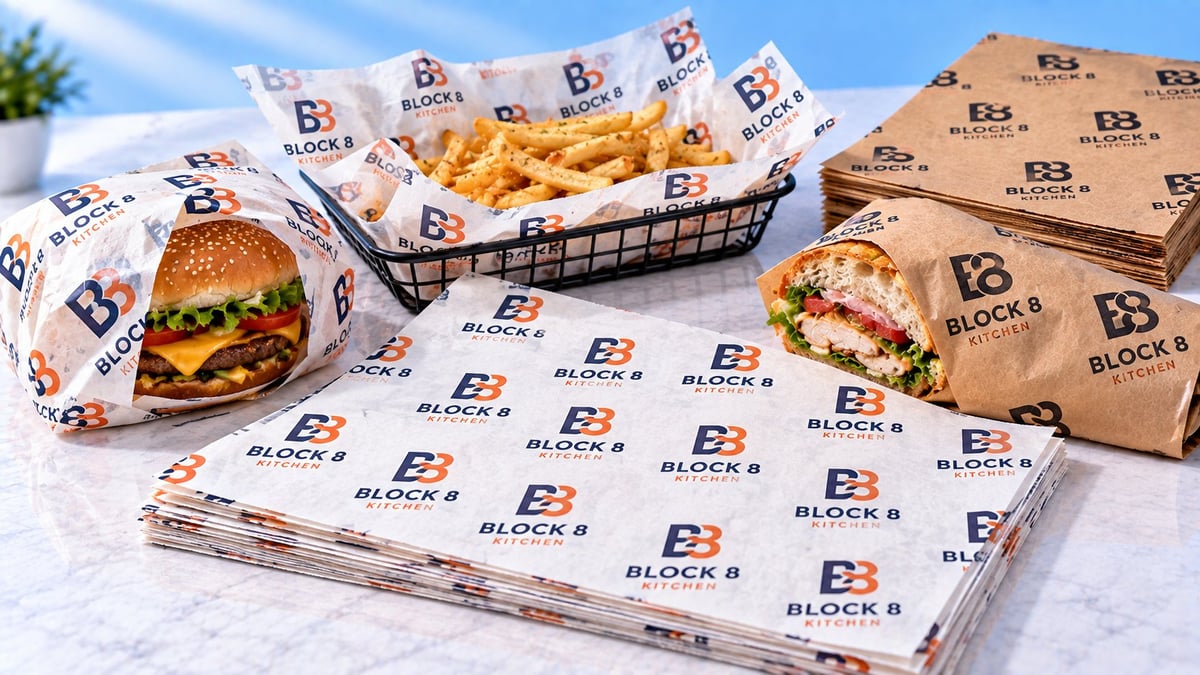
The lowest-cost branded items here, and often the ones that put your name on the most surfaces per order.
Finishing and front-of-house service
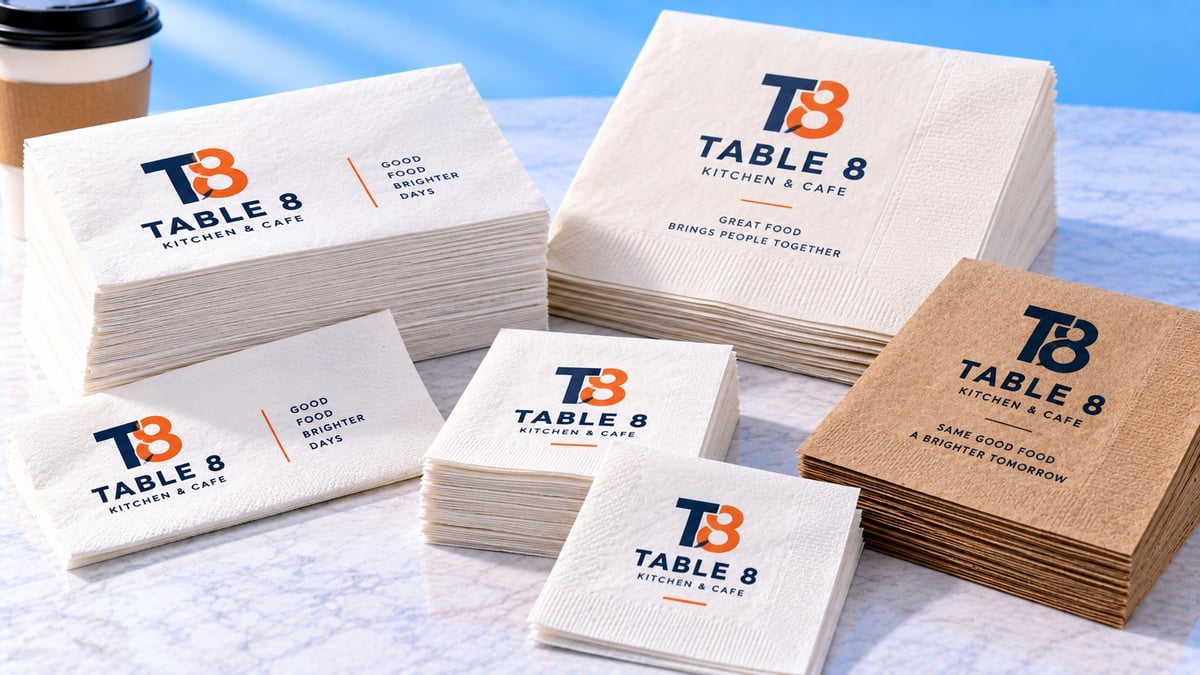
Labels brand a container you already buy and carry required information. Napkins are the item every customer touches.
Every size and configuration is confirmed with your quote. What this section does is narrow the direction before you get there.
Explore Foodservice Packaging
The complete family. Open any product to configure its dimensions, material and print.
11 products
Paper & Liners3
Boxes4
Custom Kraft Takeout Boxes
Kraft boxes for takeout, delivery, and catering.
View & Configure →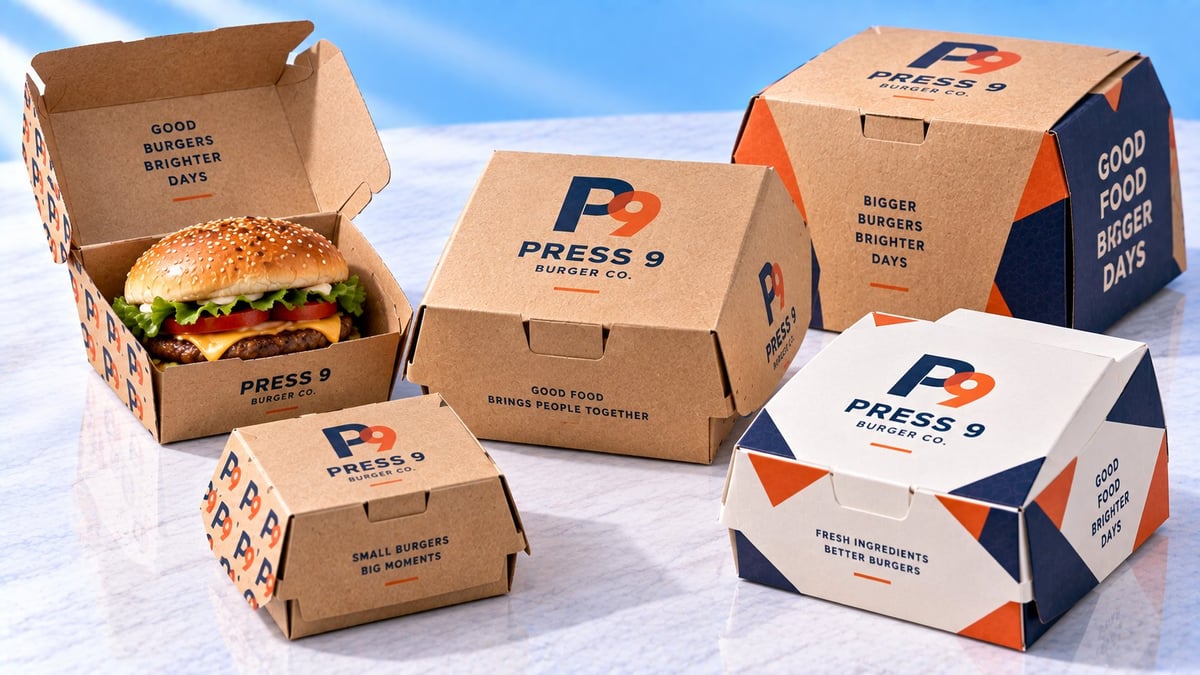
Custom Burger Boxes
Printed boxes sized for burgers and hot sandwiches.
View & Configure →
Custom Sandwich Boxes
Boxes for sandwiches, wraps, and lunch service.
View & Configure →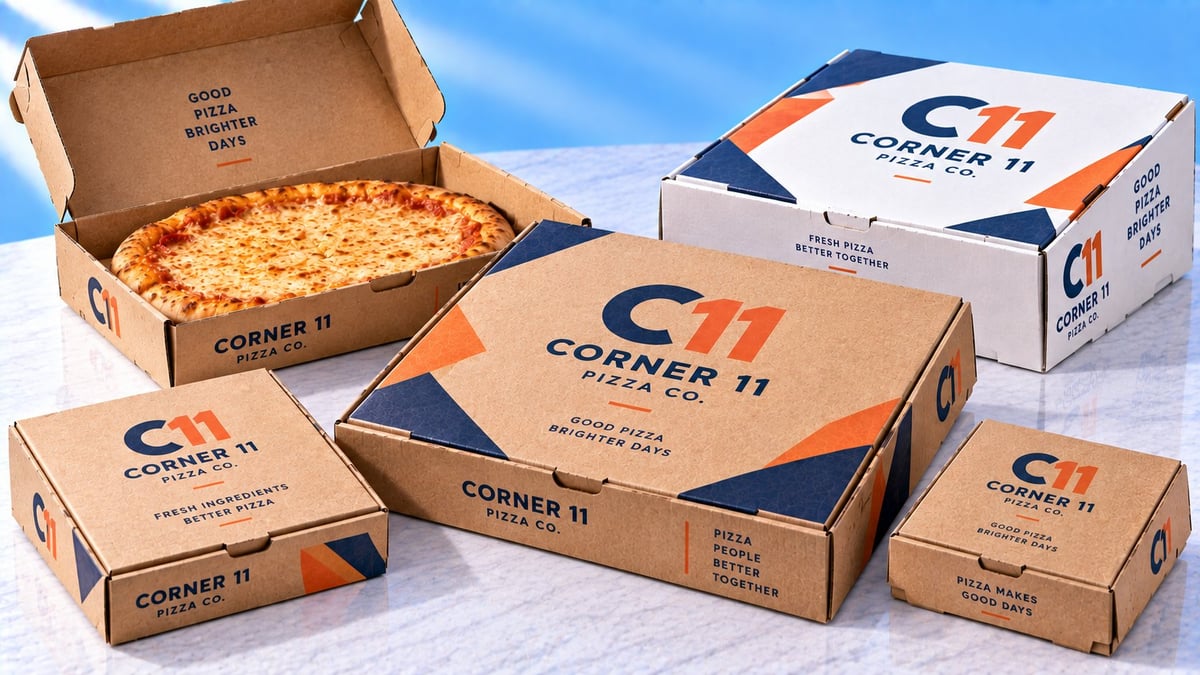
Custom Pizza Boxes
Printed pizza boxes in standard and custom sizes.
View & Configure →Containers & Bowls3
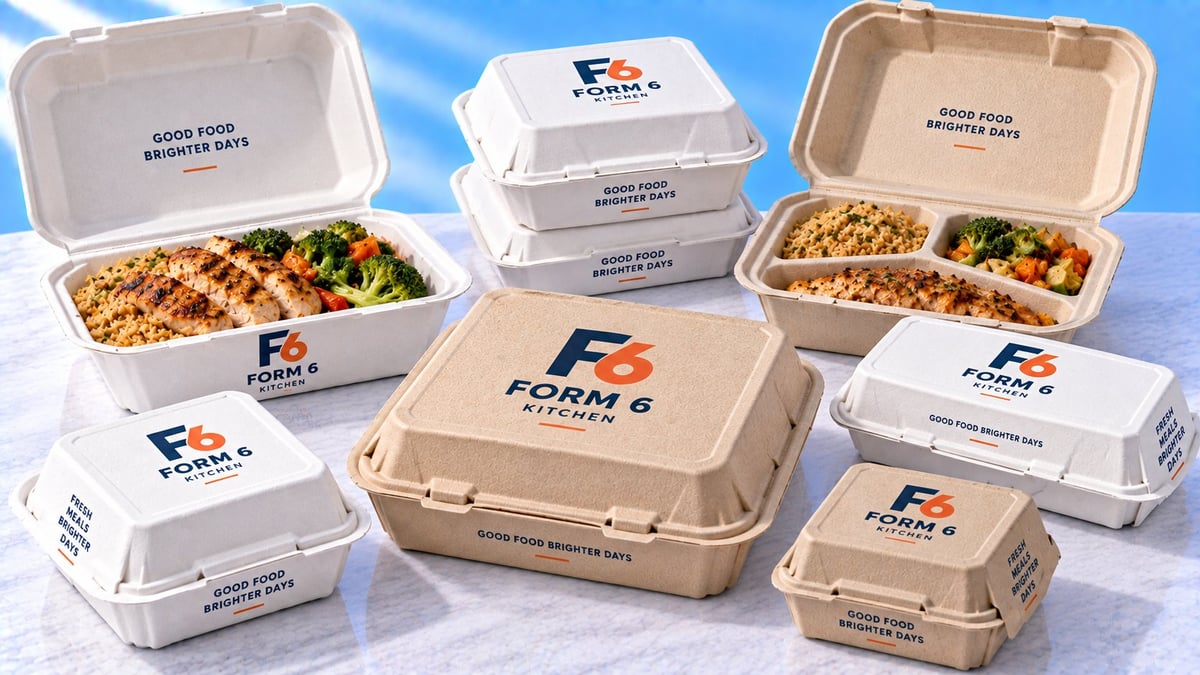
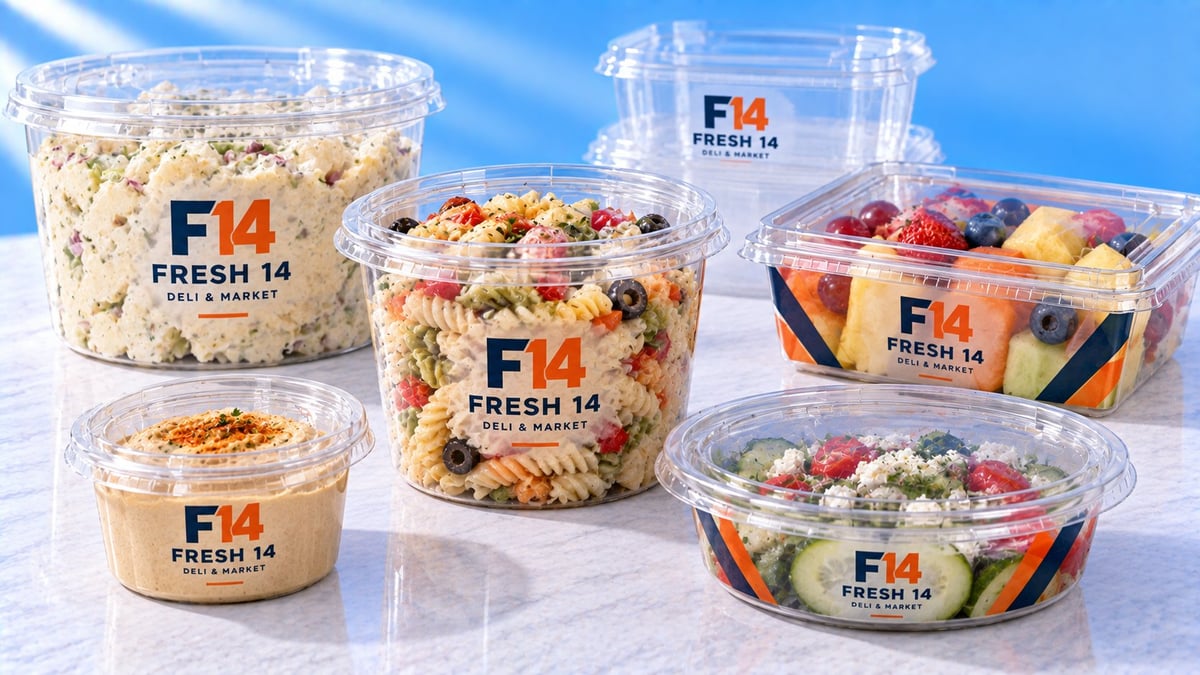
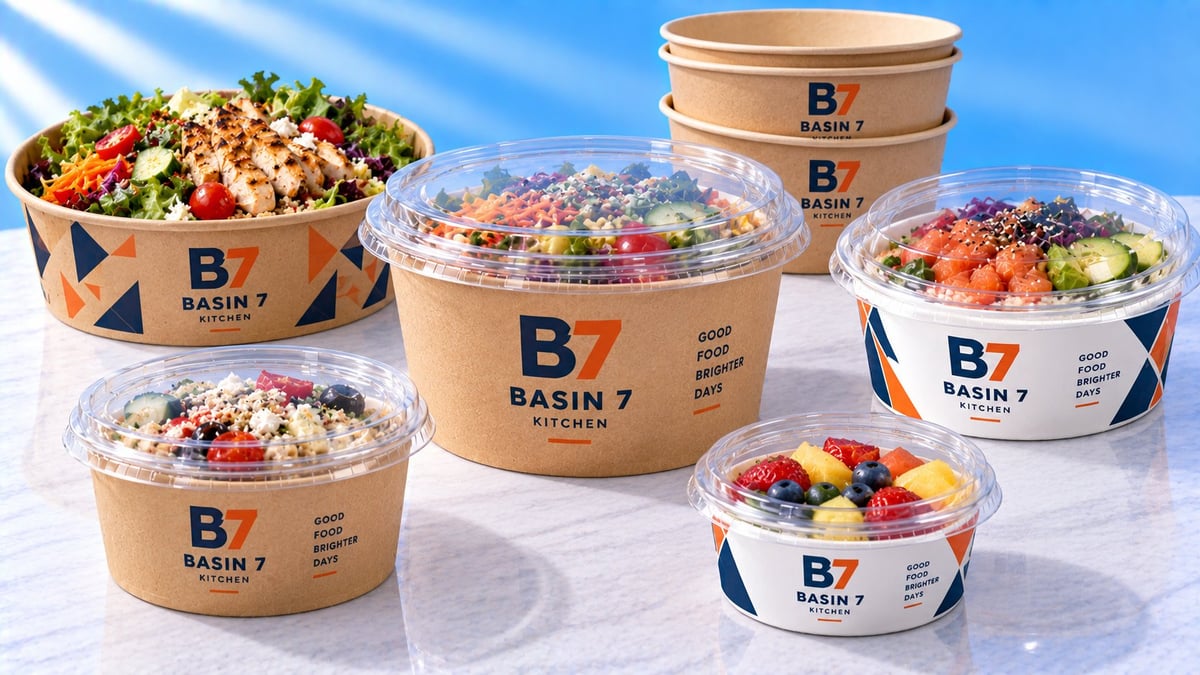
Labels1
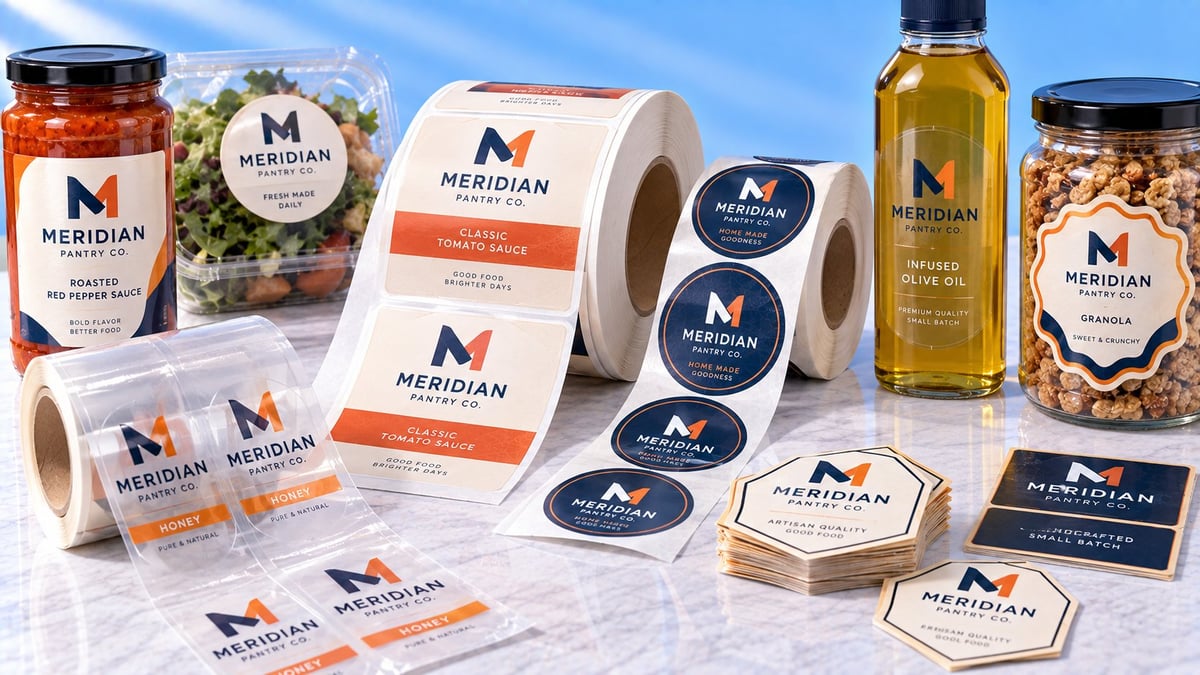
Pricing shown anywhere on this site is an estimate. Final pricing is confirmed with your quote before production. See how ordering works.
How does the food leave your kitchen?
The same dish is a different packaging decision depending on whether it is eaten in, carried out or delivered.
Dine-in presentation
Food is plated or lined and eaten where it is served, so the packaging is doing presentation work rather than carrying work.
Usually decided by: Appearance and the surface the food sits on
Counter service
Staff pack quickly, often one-handed, with limited space behind the counter. How the format stores before use matters as much as the format itself.
Usually decided by: How it stores, how fast it packs, how it stacks
Grab and go
The customer takes it from a display and carries it themselves. The pack has to read clearly on a shelf and be easy to pick up.
Usually decided by: Shelf presence and how the pack closes
Takeout and pickup
It is carried out by hand, usually a short distance, and often stacked with other items. Closure style is worth settling early rather than assuming.
Usually decided by: Closure style and how the pack stacks with others
Delivery
The pack is handed to a third party, spends time in a car or on a bike, and is opened by the customer rather than by staff. This is where the closure matters most.
Usually decided by: How it travels, and how cleanly it opens
Catered service
Food is prepared in one place and served in another, sometimes for a set number of guests. Portion consistency across many identical packs matters more than usual.
Usually decided by: Portion consistency and packing volume at scale
Retail-adjacent prepared food
Prepared food sold alongside retail goods, where the pack is often carried further and kept longer than a takeout meal.
Usually decided by: How the pack holds up once it leaves the counter
None of this is a claim about what a format can hold. The appropriate specification for your dish is confirmed for the configuration you order, which is the only place it can be confirmed accurately.
Planning sizes and portions
Two decisions sit inside sizing: how much it holds, and how it is arranged. The bands below are the ones these products are usually configured in.
6×6×3 · 9×6×3 · 8×8×3 three-compartment · 9×9×3 single and three-compartment
Footprint follows the plate it replaces; compartment count follows the menu.
Configure the size8 oz · 16 oz · 32 oz · 64 oz
Capacity follows the portion, and the lid is specified with the tub.
Configure the size16 oz · 24 oz · 32 oz · 48 oz
Capacity follows the build, including the toppings that sit on top.
Configure the size8 in · 10 in · 12 in · 14 in · 16 in · 18 in
Diameter is the specification. Depth follows the crust.
Configure the sizeBeverage · Luncheon · Dinner · Dispenser
Format follows where the napkin is used, not a dimension.
Configure the sizeSmall · Medium · Large
Bands are a starting point. Enter what you serve and we confirm the build.
Configure the sizeSingle · Double and smash · Slider pack
The build decides the depth rather than a numbered size.
Configure the sizeSmall · Medium · Large · Wedge
Cut length and whether it is served whole or halved decide it.
Configure the sizePaper and labels work the other way
Greaseproof paper, deli paper and food labels are configured from your own dimensions rather than from a fixed list, so there are no bands to publish. Bring the sheet size you currently use, or the container the label has to fit, and that becomes the specification.
These bands show how the sizing decision works. They are commonly manufactured formats rather than a stock list, and exact dimensions are confirmed with your quote.
Before you choose a format
Eight things worth knowing about your own operation first. In this family the food narrows the material before preference gets a say.
What is going in it
Wet, dry, saucy, wrapped or loose. This is the first thing that narrows the material, and it is why the same business often runs three different containers.
How it is portioned
A single serve and a sharing portion of the same dish can need different formats, and the menu usually settles it before anything else.
Wrapped, boxed, bowled or contained
These are four different jobs. A wrap sheet is not a cheaper box, and a bowl is not a container with the lid off.
How it leaves the building
Dine-in, counter, pickup and delivery put different demands on the same food, and the format that suits one may not suit another.
Whether it needs to close
Some formats close themselves, some take a lid, and some are wrapped. Whether the food has to stay covered in transit decides a lot, and where a lid is used it is specified together with the container it fits.
Where the branding goes
A pizza lid, a clamshell top and a wrap sheet are all large flat surfaces. A domed lid is not. Artwork placed for the wrong face is the most common waste in this family, so it is worth settling at mockup stage.
How it looks when it arrives
Presentation is a real requirement, not a soft one. A pack that arrives looking careless undoes the food inside it.
Any requirement you need verified
If your business, a customer or a contract imposes a requirement on the packaging, state it up front. A requirement raised early is designed into the configuration.
On performance properties
Whether a material is suitable for your food depends on the exact product and configuration you order, so we confirm it against your specification rather than making general statements that would have to hold across the whole family.
Where a property is verified for a specific product, we state it for that product. Where it is not, we do not assert it. If your business, a customer or a contract imposes a requirement on the packaging, raise it when you request a quote and it is designed into the specification.
Branding a full takeout order
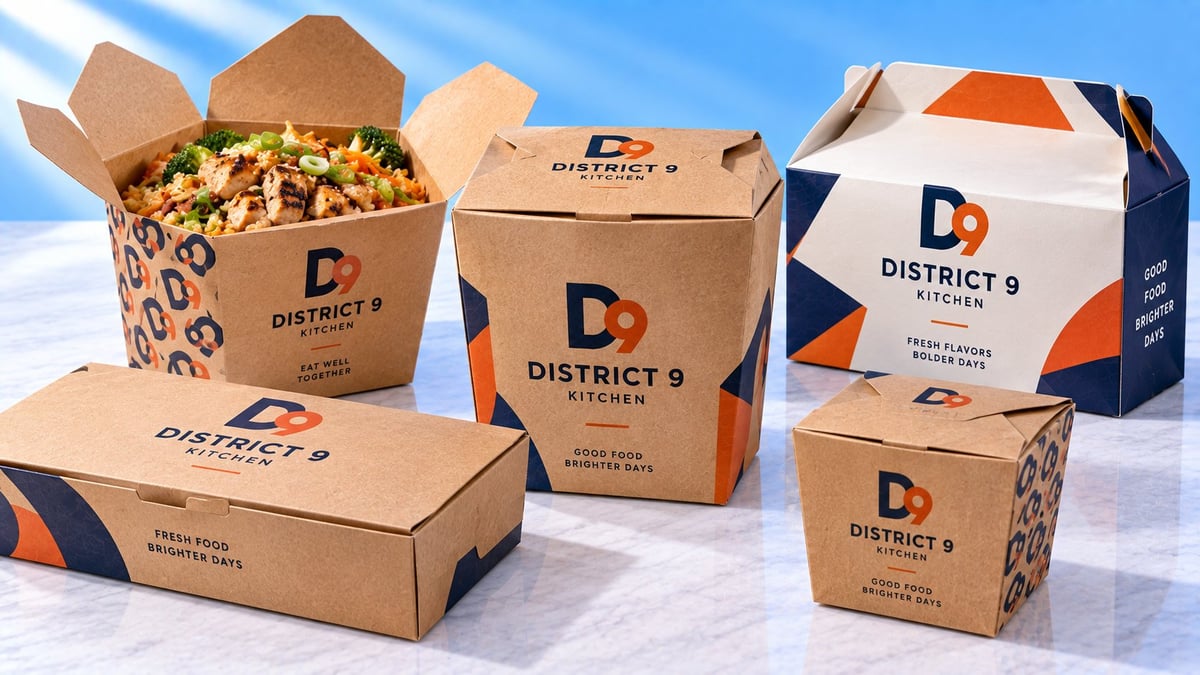
A takeout order is usually four or five different items. Printing them from one artwork set is what makes them read as one brand.
One brand, several items
A full takeout order is usually four or five different items. Printing them from one artwork set is what makes them read as one brand rather than as packaging bought in separate decisions.
Where the customer is looking
The lid of a pizza box is seen from above. A clamshell is seen from the top. A wrap sheet shows whichever face is up when it lands. Artwork placed for the wrong face is wasted print.
The printable area varies
A flat panel and a curved or ribbed surface are not the same amount of usable space, and a napkin holds bold marks better than fine detail. Print area is confirmed against the format you order.
What you need to send
A logo file is enough to start. Vector artwork is the cleanest route to print, particularly when the same mark has to sit on a box, a wrap sheet and a label at different sizes.
Labels carry more than branding
A label is also where required product information sits. Branding and compliance are usually the same small surface, which is worth settling early rather than adding later.
Consistency across a range
The printing is what keeps a burger box, a wrap sheet and a napkin recognisably from the same kitchen when a customer has all three in front of them.
You do not need finished artwork to start. A logo file on its own is enough, and we will tell you what is needed to prepare it for the format you have chosen.
Accepted formats: AI, EPS, SVG, PDF, PNG, JPG or JPEG
Vector is the cleanest starting point for print, but it is not a requirement to enquire.
Artwork and design helpSee Your Packaging Before Production
Two separate things, and buyers often conflate them. One is free and part of every order. The other is optional and quoted.
Digital mockup
Your artwork shown on the packaging you have specified, at the dimensions, material and print coverage you chose. It is free, no production order is required to receive it, and nothing is manufactured until you approve it.
- Free, and available once your artwork is submitted
- Your artwork placed on the packaging configuration you selected
- No production order is needed first
- Reviewed with you before anything is manufactured
Custom physical sample
If you would rather hold the packaging before committing to a run, a physical sample of your own specification can be produced. It is separate from the digital mockup, and most customers move straight from mockup to production.
- Artwork is approved before the sample is made, so the sample matches what you would actually run
- Approximately 2 to 3 weeks after artwork approval
- Approximately $150 to $250 depending on the product and configuration
- Credited toward your production order if you go ahead
Comparing the main formats
Grouped so you compare like with like. Each group covers what the format does, where it is used, how it is sized and where your branding goes on it.
Paper and wrap
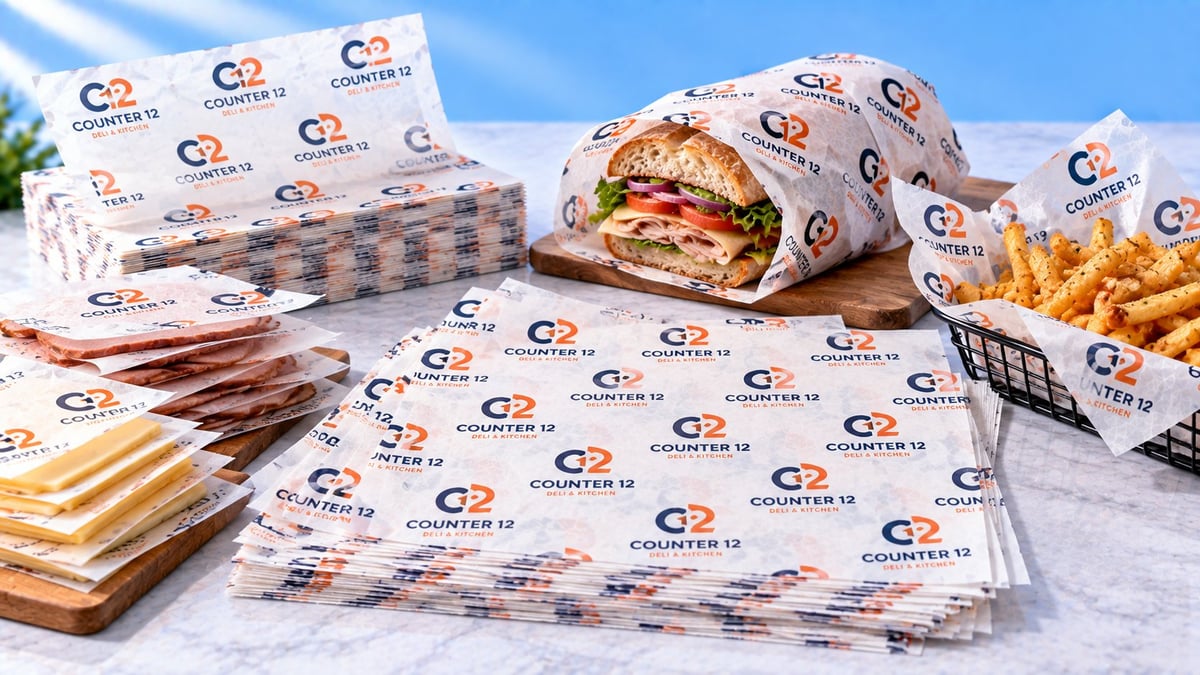
Wrapping and lining. The lowest-cost branded items in the family, and often the ones that reach the most surfaces per order.
| Greaseproof Paper | Deli Paper | Food Labels | |
|---|---|---|---|
| What it does | Dense sheet for lining baskets and wrapping fried or greasy food | Sheet for deli counters, sandwich service and interleaving | Small printed face applied to a container you already use |
| Common serving situation | Baskets, trays and food served straight onto paper | Deli counters, sandwich assembly and wrapped service | Sealed tubs, jars, bags and any packaged item |
| Formats | Interleaved sheets, cut sheets and rolls | Interleaved and cut sheets | Any shape or dimension, on paper or film stocks |
| Branding role | Repeat pattern or all-over print across the sheet | Printed sheet face, seen when the food is unwrapped | Small but high-frequency: one per item sold |
Greaseproof Paper
- What it does
- Dense sheet for lining baskets and wrapping fried or greasy food
- Common serving situation
- Baskets, trays and food served straight onto paper
- Formats
- Interleaved sheets, cut sheets and rolls
- Branding role
- Repeat pattern or all-over print across the sheet
Deli Paper
- What it does
- Sheet for deli counters, sandwich service and interleaving
- Common serving situation
- Deli counters, sandwich assembly and wrapped service
- Formats
- Interleaved and cut sheets
- Branding role
- Printed sheet face, seen when the food is unwrapped
Food Labels
- What it does
- Small printed face applied to a container you already use
- Common serving situation
- Sealed tubs, jars, bags and any packaged item
- Formats
- Any shape or dimension, on paper or film stocks
- Branding role
- Small but high-frequency: one per item sold
Boxes
Rigid formats where the box itself is most of the presentation. These carry the largest uninterrupted print surfaces in the family.
| Kraft Takeout Boxes | Burger Boxes | Pizza Boxes | |
|---|---|---|---|
| What it holds | General takeout and catering portions, including multi-item orders | Burgers, hot sandwiches and slider sets | Whole pizzas, by diameter |
| What decides the size | What has to fit inside and how it is packed | The build and the number of patties | The pizza diameter |
| Closure | Hinged lid and separate lid styles | Hinged, opening away from the customer | Full-lid corrugated, the largest flat branding surface here |
| Branding role | Side and lid panels, seen while carried | The lid, seen on the tray and in the hand | The lid, seen from above more than any other format |
Kraft Takeout Boxes
- What it holds
- General takeout and catering portions, including multi-item orders
- What decides the size
- What has to fit inside and how it is packed
- Closure
- Hinged lid and separate lid styles
- Branding role
- Side and lid panels, seen while carried
Burger Boxes
- What it holds
- Burgers, hot sandwiches and slider sets
- What decides the size
- The build and the number of patties
- Closure
- Hinged, opening away from the customer
- Branding role
- The lid, seen on the tray and in the hand
Pizza Boxes
- What it holds
- Whole pizzas, by diameter
- What decides the size
- The pizza diameter
- Closure
- Full-lid corrugated, the largest flat branding surface here
- Branding role
- The lid, seen from above more than any other format
Containers
Formats defined by capacity and closure rather than by footprint. The lid is part of the specification, not an accessory.
| Sugarcane Clamshells | Deli Containers | Salad Bowls | |
|---|---|---|---|
| What it holds | Plated meals, takeout portions and multi-compartment service | Deli, prepared and grab-and-go food by capacity | Salads, grain bowls and poke |
| What decides the size | The plate it replaces, and whether components stay apart | The portion in ounces | The build including toppings |
| Closure | Hinged, formed with the base | Separate lid, specified with the tub | Separate lid, specified with the bowl |
| Branding role | The top face, seen from above in transit | Lid and side wall | Lid, and the visible side wall through a clear bowl |
Sugarcane Clamshells
- What it holds
- Plated meals, takeout portions and multi-compartment service
- What decides the size
- The plate it replaces, and whether components stay apart
- Closure
- Hinged, formed with the base
- Branding role
- The top face, seen from above in transit
Deli Containers
- What it holds
- Deli, prepared and grab-and-go food by capacity
- What decides the size
- The portion in ounces
- Closure
- Separate lid, specified with the tub
- Branding role
- Lid and side wall
Salad Bowls
- What it holds
- Salads, grain bowls and poke
- What decides the size
- The build including toppings
- Closure
- Separate lid, specified with the bowl
- Branding role
- Lid, and the visible side wall through a clear bowl
This table compares how the formats are used, not what they are made of. Material and performance questions depend on the exact product and are confirmed with your quote.
How custom pricing works
Foodservice packaging is quoted per project rather than sold at a list price, because the number moves with the build.
The format and its dimensions
A larger box or a deeper container uses more material. Dimensions are the first thing the price moves with.
The configuration
Compartments, lid style, closures and any interior feature are separate parts of the build, and each is its own line.
Print coverage
A single mark on a lid and full coverage across a wrap sheet are different amounts of print. Coverage is priced as it is specified.
Quantity
Fixed setup and freight spread across more units as the run grows, which is why the per-unit position improves on larger orders.
Artwork preparation
If the artwork needs work before it can print, that is a one-time cost and it is stated rather than absorbed silently.
Delivery
Freight is quoted against your delivery address. Rigid and bulky packaging does not compress the way flat stock does, so it is a real part of the cost.
Ordering across a family
A full takeout setup usually spans several products, and ordering them together is quoted as one order. That gives you one delivery and one point of contact rather than four, and it means the artwork is prepared once across the whole set. Minimums vary by product and configuration, so they are confirmed on the quote rather than published as a single figure.
- The packaging itself, in your dimensions
- The closure or lid, specified with the container
- Printing, at the coverage you have chosen
- Any artwork preparation that is needed
- Delivery to your address
Your quote states what the price includes rather than leaving you to work it out.
Request Custom PricingWho buys foodservice packaging
The formats change with the operation, but the questions are usually the same: what leaves the kitchen, how it travels, and how quickly it has to be packed.
Restaurants
The widest spread of formats, because a menu has hot, cold, wrapped and contained items on it.
See the packagingFood Trucks
Storage space is the constraint. Formats that nest and stack before service matter as much as the pack itself.
See the packagingCatering Companies
Many identical packs served away from the kitchen, where portion consistency across the run is the priority.
See the packagingDelis
Counter service, wrapping and prepared food by weight or portion. Papers and containers do most of the work.
See the packagingBakeries
Food that often leaves in a bag rather than a box, with labels carrying the product information.
See the packagingCoffee Shops
Drinks sit in the Cups family. The food case is what brings them here: pastries, sandwiches and wrapped items.
See the packagingHow ordering works
Once the packaging configuration and pricing are settled, we move through artwork review, mockup approval and the remaining order steps.
- 01
Tell us what you serve
The dish, the portion and how it leaves the building. That is enough to narrow the format before anything else is decided.
- 02
Settle the configuration
Format, dimensions, compartment or capacity, closure and quantity. If you are reordering, your previous specification already covers this.
- 03
Send what artwork you have
Finished artwork or a logo file on its own. If the artwork needs preparing for the format, we review it and tell you what is needed.
- 04
Review pricing for the build
A quote is prepared for the configuration you asked for, including what the price covers, rather than a rate off a list.
- 05
Approve the free digital mockup
Your artwork on the packaging you specified, at no charge and with no production order required. You review it before the order moves forward.
- 06
Order a physical sample, if you want one
Optional, and only after the artwork is approved. If you would rather move straight to production, that is entirely normal.
- 07
Production and delivery
Once the configuration, artwork and pricing are settled, the order moves into production and is delivered to your address.
Completing the rest of the order
Food packaging is usually part of a larger order. These two families cover the rest of it, and they are quoted alongside this one.
Serving drinks with the meal
Cups, lids, sleeves and carriers live in their own family. If the order includes a drink, that is where those items sit.
Browse Cups & DrinkwareSending it out in a bag
Takeout bags, SOS bags, bakery bags and retail shopping bags are built around what fits inside them. That is a different family with its own sizing logic.
Browse Bags & BakeryWhy work with YaSeen Packaging
YaSeen Packaging works directly with packaging manufacturers to provide custom packaging produced around your product and brand. That is how a configuration outside a standard list becomes a question worth asking rather than a limitation, and how a quote can be prepared against a specific specification rather than an approximation of one.
It matters here because a takeout order is usually several packaging products that have to work together. The person who quotes the box is the same person who can tell you whether the container beside it suits the food going in, so the quote covers the whole order rather than one item at a time.
- Formats chosen against what you serve, not a stock list
- A free digital mockup before anything is manufactured
- Artwork prepared and reviewed against the format you pick
- Several packaging products quoted as one order
- Repeat orders confirmed from your saved specification
Questions about foodservice packaging
What buyers ask most, answered. If yours is not here, ask it when you request pricing.
Ask us about your orderWhat is custom foodservice packaging?
How do I choose the right takeout packaging?
What packaging works for burgers?
What packaging works for sandwiches and wraps?
When should I use deli paper or greaseproof paper?
How do I choose a takeout container size?
Can I add my logo to foodservice packaging?
Can I order several foodservice packaging products together?
What is the minimum order?
How is custom pricing determined?
Do I receive a digital mockup?
Can I order a physical sample?
How should I prepare artwork?
Do you offer compostable or microwave-safe packaging?
Do you sell cutlery or gloves?
Do you ship foodservice packaging?
Guides that help with this family
Tell us the dish, we will match the packaging
Send what you serve, how it leaves the building, and roughly how much you go through. We will come back with the formats that fit and pricing for your configuration.